

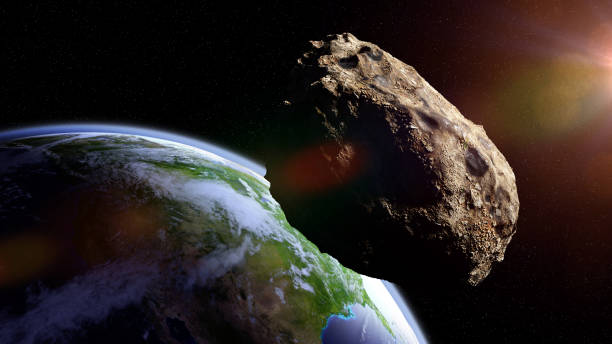
A newly tracked asteroid named 2026 FQ2, roughly the size of a bus, is making a close approach to Earth today. Despite its proximity, scientists have confirmed there is no threat of collision. Experts explain why such flybys are common and how global space agencies monitor these objects to ensure planetary safety.
In a development that has sparked curiosity across the globe, a bus-sized asteroid identified as 2026 FQ2 is passing close to Earth today. While the phrase “asteroid approaching Earth” often triggers concern, scientists and space agencies have reassured the public that this event is entirely safe and part of routine cosmic activity. The asteroid, estimated to be similar in size to a standard city bus, is categorized as a near-Earth object (NEO) — a class of space rocks whose orbits bring them relatively close to our planet. Despite its classification, experts confirm there is absolutely no risk of impact. According to observational data, the asteroid will pass Earth at a distance of roughly 1.5 million miles — which is more than six times the distance between the Earth and the Moon. This distance may sound small in astronomical terms, but it is considered extremely safe by scientists. Why This Asteroid Is Not Dangerous One of the main reasons scientists are unconcerned is the asteroid’s size and trajectory. Objects like 2026 FQ2 are significantly smaller than those capable of causing global damage. In fact, even if a similar object were to enter Earth’s atmosphere, it would most likely burn up due to friction, creating a bright fireball rather than causing destruction. Experts use advanced tracking systems to calculate the exact orbit of such objects. These calculations are so precise that scientists can predict the asteroid’s path years — sometimes decades — in advance. In this case, all models confirm that 2026 FQ2 will safely bypass Earth. A Routine Event in Space While headlines about asteroids often create excitement, the reality is that such flybys are extremely common. Space agencies track tens of thousands of near-Earth objects, many of which pass by Earth every year without posing any risk. These regular flybys are a natural part of our solar system’s dynamics. Earth shares its cosmic neighborhood with countless rocks and debris left over from planetary formation. Most of these objects remain in stable orbits around the Sun, occasionally crossing Earth’s path — but at safe distances. How Scientists Track Asteroids Monitoring asteroids like 2026 FQ2 is a highly sophisticated process involving multiple observatories and technologies. Space agencies rely on: Ground-based telescopes Radar imaging systems Infrared detection tools Automated sky surveys Programs such as asteroid detection networks continuously scan the sky for new objects. Once detected, astronomers calculate the asteroid’s orbit using repeated observations. This helps determine its speed, direction, and future trajectory. The data is then analyzed by specialized centers that assess whether the object poses any risk. If there is even a slight possibility of impact, the asteroid is closely monitored and updated in global databases. Why Scientists Still Study Small Asteroids Even though 2026 FQ2 is not dangerous, its flyby is still scientifically valuable. Every asteroid encounter provides researchers with an opportunity to improve tracking techniques and refine predictive models. Studying small asteroids helps scientists: Understand the composition of early solar system material Improve detection accuracy for larger threats Test planetary defense strategies Enhance global coordination for space monitoring In many ways, harmless asteroids like 2026 FQ2 serve as “practice runs” for scientists preparing for potential future risks. Public Curiosity vs Scientific Reality The idea of an asteroid passing “close” to Earth often creates viral buzz online. However, what is considered “close” in space is vastly different from everyday human perception. To put things into perspective, even objects passing within a few hundred thousand miles are still at a safe distance. For an asteroid to pose a genuine threat, it would need to be both significantly larger and on a direct collision course — conditions that are not met in this case. Visibility and Observation For those hoping to catch a glimpse of the asteroid, there is a slight disappointment. Due to its small size and distance, 2026 FQ2 will not be visible to the naked eye or even most amateur telescopes. However, space enthusiasts can track its movement through online dashboards and live data platforms provided by space agencies. These tools offer real-time updates on asteroid positions and trajectories. The Bigger Picture: Planetary Defense Events like this highlight the importance of planetary defense systems. Governments and space agencies around the world are investing in technologies to detect, track, and potentially deflect hazardous asteroids. Recent missions have already demonstrated the ability to alter an asteroid’s trajectory — a breakthrough that could prove crucial in the future. While 2026 FQ2 poses no threat, it serves as a reminder of why continuous monitoring is essential. The more scientists learn about near-Earth objects, the better prepared humanity will be for any real danger. Conclusion of This Phase As asteroid 2026 FQ2 makes its safe passage past Earth, scientists remain confident that there is nothing to worry about. Instead of danger, this event represents progress — a testament to how far space science has come in understanding and tracking our cosmic surroundings.
The flyby of asteroid 2026 FQ2 may appear like a dramatic celestial event, but in reality, it is part of a much larger and fascinating system of space monitoring and planetary science. To truly understand why scientists are calm about such events, one must look deeper into how asteroids are classified, tracked, and evaluated. Understanding Near-Earth Objects Near-Earth objects (NEOs) include asteroids and comets whose orbits bring them within a certain distance of Earth. These objects are closely monitored because they have the potential — however small — to intersect with Earth’s orbit. However, not all NEOs are dangerous. In fact, only a tiny fraction are classified as potentially hazardous asteroids (PHAs). To fall into this category, an asteroid must: Be larger than approximately 140 meters Come within 7.5 million kilometers of Earth Asteroid 2026 FQ2 does not meet either of these criteria. Its small size and safe distance automatically rule out any possibility of danger. The Scale of Space Distances One of the biggest misconceptions about asteroid flybys is the idea of “closeness.” In everyday terms, a distance of 1.5 million miles might seem small. But in space, this is an enormous gap. For comparison: Distance from Earth to Moon: ~384,000 km Distance of asteroid 2026 FQ2: ~2.4 million km This means the asteroid is passing far beyond the Moon’s orbit, ensuring complete safety. Frequency of Asteroid Flybys Asteroids of similar size pass near Earth quite frequently. In fact, scientists observe multiple such flybys every month. Most of these events go unnoticed by the public because they pose no threat. Occasionally, however, media coverage brings attention to these events, creating a mix of curiosity and concern. What Happens If a Small Asteroid Hits Earth? Even though 2026 FQ2 will not impact Earth, it raises an interesting question: what would happen if a similar object did? For asteroids of this size: Most would burn up in the atmosphere Some could create bright fireballs or sonic booms Rarely, small fragments might reach the ground Such events are generally harmless and occur naturally over time. Advancements in Detection Technology The ability to detect asteroids like 2026 FQ2 is a result of decades of technological advancement. Modern systems can identify objects just a few meters wide — something that was nearly impossible a few decades ago. Key advancements include: Wide-field sky surveys Artificial intelligence in data analysis Global collaboration between observatories Real-time tracking systems These innovations ensure that even small objects are detected early and tracked accurately. International Collaboration Asteroid monitoring is not limited to a single country. It is a global effort involving multiple space agencies, research institutions, and observatories. Data collected from different parts of the world is shared and analyzed collectively. This collaborative approach improves accuracy and ensures that no potential threat goes unnoticed. Public Awareness and Media Impact While scientific communities treat such flybys as routine, public perception often differs. Headlines about asteroids can quickly go viral, especially on social media. This highlights the importance of accurate information. By explaining the science behind these events, experts aim to reduce unnecessary panic and promote understanding. Preparing for the Future Although 2026 FQ2 is harmless, the study of such objects plays a crucial role in preparing for potential future threats. Scientists are continuously developing strategies to deal with hazardous asteroids. These include: Deflection missions Early warning systems Impact simulation models Emergency response planning The goal is to ensure that humanity is never caught off guard. A Reminder of Our Cosmic Environment Asteroids like 2026 FQ2 are remnants of the early solar system. They offer valuable insights into how planets formed and evolved. Each flyby provides a chance to study these ancient objects up close — without the risks associated with larger asteroids. Final Thoughts The passage of asteroid 2026 FQ2 is not a cause for alarm but an opportunity for learning. It showcases the effectiveness of modern science in tracking and understanding space objects. As technology continues to improve, our ability to monitor the cosmos will only get better. For now, events like this serve as a fascinating reminder of the dynamic universe we live in — and the remarkable systems in place to keep us safe.